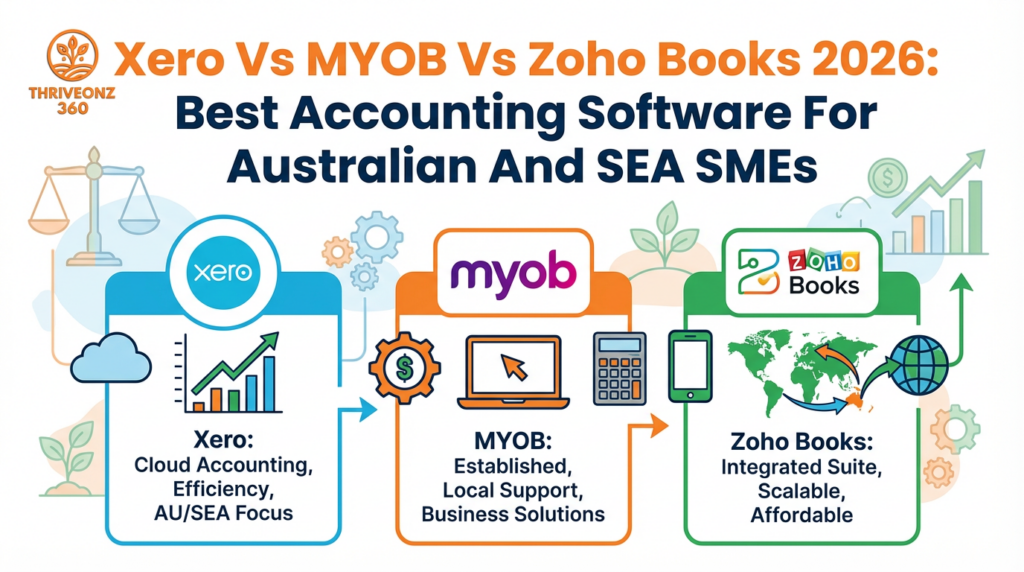
Xero vs MYOB vs Zoho Books 2026: Best Accounting Software for Australian and SEA SMEs
Last Updated on June 20, 2026 by James Hartley
Last Updated: April 2026 · Editorial Team
Xero vs MYOB vs Zoho Books 2026 — quick verdict: Xero is the best accounting software for most Australian SMEs in 2026 — dominant accountant adoption, most reliable bank feeds, strongest GST/BAS generation, and the widest app ecosystem. MYOB wins for complex payroll (20+ employees, Award compliance, construction) and costs significantly less at $54/month with unlimited employees included. Zoho Books wins on price for early-stage businesses and multi-currency for Australia-SEA dual operations. The single most decisive factor: what platform your accountant uses. If your accountant recommends Xero, use Xero. If MYOB, use MYOB. The accountant workflow advantage compounds every year-end.
🇦🇺 The Message Every Australian SME Owner Dreads — And Why Your Accounting Platform Is the Root Cause
Your accountant’s March message:
- Bank feed stopped syncing in October — nobody noticed
- GST coded incorrectly on 12 invoices across Q2 and Q3 — both BAS lodgements need amendment
- Three termination payments processed without correct withholding — now needs an ATO letter
- The file is technically operational but requires 3 weeks of cleanup before annual accounts can begin
This scenario costs Australian SMEs an estimated $2.8 billion annually in unnecessary accounting fees — the incremental cost of cleaning up data that should have been captured correctly in the first place.
✅ What the right accounting platform prevents:
The right accounting software for an Australian business materially reduces the probability of this scenario by making correct data capture the path of least resistance: bank feeds that sync reliably, GST codes that default correctly, STP that files automatically, and BAS reports that pull from properly coded transactions.
Three platforms define the accessible accounting software market for Australian and SEA SMEs in 2026: Xero (market share leader, strongest bank feeds, dominant accountant ecosystem), MYOB (established Australian incumbent, deepest payroll and compliance), and Zoho Books (most affordable with strong multi-currency for international businesses). The right choice depends on one primary factor: where your business is, and where it is going.
📊 Six Numbers That Define the Australian Accounting Software Decision
$2.8B/yr
Estimated annual cost to Australian SMEs of unnecessary accounting fees from poor data quality — incorrect GST coding, unreconciled bank feeds, payroll errors requiring ATO correction.
1.3M
Xero subscribers in Australia — out of 4.2M globally. Xero overtook MYOB as the preferred platform of Australian accounting firms by 2019–2020. Most Australian accounting firms now use Xero as their default.
$504/yr
MYOB Standard ($54/month) annual saving vs. Xero Standard + KeyPay ($65 + $60/month) for a 25-employee Australian business. MYOB Standard includes unlimited employees in STP-compliant payroll.
$0
Zoho Books Free plan — the only perpetual free plan in this comparison. For businesses under $50K AUD annual turnover: up to 1,000 invoices/year, bank reconciliation (import-based), GST/BAS reporting, 1 user + 1 accountant.
TPAR
The compliance requirement that disqualifies Zoho Books for building, construction, cleaning, IT, courier, and road freight industries. Xero and MYOB both support TPAR natively. Zoho Books does not.
$300–400/mo
Estimated owner time saving from reliable Australian bank feeds + Xero bank rules — reducing monthly reconciliation from 5–7 hours (manual) to 45–90 minutes (automated). At $80/hour owner time.
🇦🇺 Australia’s Four Compliance Frameworks — Why Platform Choice Matters More Here Than Elsewhere
Australia’s compliance requirements for businesses are among the most administratively demanding in Asia-Pacific. Understanding them explains why “just use whatever is cheapest” has a higher true cost in Australia than in most other markets.
1. GST and BAS (Business Activity Statement)
10% GST mandatory above $75,000 turnover. Every transaction must be coded G1–G23. Quarterly BAS lodgement. Xero’s GST defaults are strongest; MYOB is most familiar to Australian bookkeepers; Zoho requires more manual configuration.
2. STP Phase 2 (Single Touch Payroll)
Mandatory real-time ATO payroll reporting each pay cycle since 2019. Phase 2 (from Jan 2022) requires disaggregated salary, leave, allowances, and termination payments. Non-compliance attracts ATO penalties. MYOB had the earliest and most complete rollout.
3. Medicare and Superannuation
2% Medicare Levy withholding. Super Guarantee: 11.5% from July 2024, rising to 12% from July 2025. SuperStream electronic lodgement mandatory. PAYG Withholding via BAS. MYOB’s payroll engine is deepest for Australian-specific super and withholding compliance.
4. TPAR (Taxable Payments Annual Report)
Annual report of all contractor payments for businesses in building/construction, cleaning, IT, security, road freight, and courier services. Xero and MYOB both handle TPAR natively. Zoho Books does not — disqualifying for TPAR-applicable industries.
⚡ Quick Navigation
- Quick Comparison Table → — 19-factor platform comparison at a glance
- Xero — Australian Market Share Leader → — bank feeds, GST/BAS, STP, pricing, app ecosystem
- MYOB — The Australian Accounting Incumbent → — Award payroll, unlimited employees, ATO lodgement
- Zoho Books — Affordable with International Reach → — free plan, multi-currency, SEA coverage
- True Annual Cost by Business Profile → — three realistic cost scenarios
- Australian Compliance Scorecard → — GST, BAS, STP, TPAR, SuperStream comparison
- Bank Feed Reliability → — Australian banks by platform
- Australia-Singapore Dual Jurisdiction → — three platform configuration options
- Four Use Case Scenarios → — café, software consultancy, e-commerce, construction
- Decision Framework → — choose Xero vs MYOB vs Zoho Books by use case
- Xero Review 2026 — Full Pricing, Features, Pros & Cons →
- Best Accounting Software Singapore 2026 →
Quick Comparison Table: Xero vs MYOB vs Zoho Books 2026
| Feature | Xero | MYOB | Zoho Books |
|---|---|---|---|
| Best For | GST businesses, accountant-connected, multi-currency | Complex payroll, Award compliance, established businesses | Budget-conscious, SEA operations, multi-currency |
| Starting Price (AUD) | $32/month (Starter) | $27/month (Lite) | $0 (Free plan) |
| Australian GST and BAS | ✅ Best-in-class | ✅ Excellent | ✅ Good (config needed) |
| STP Phase 2 | ✅ Yes | ✅ Yes (earliest rollout) | ⚠️ Basic |
| SuperStream | ✅ Yes | ✅ Most complete | ⚠️ Limited |
| TPAR | ✅ Yes | ✅ Yes | ❌ No |
| Bank Feeds (Australian Banks) | ✅ Best (direct all majors) | ✅ Good | ⚠️ Import-based many banks |
| Payroll Employee Cap | ⚠️ 1–20 depending on plan | ✅ Unlimited (Standard+) | ⚠️ Basic payroll |
| Australian Award Compliance | ⚠️ Basic (use KeyPay) | ✅ Most complete | ⚠️ Basic |
| Multi-Currency | ✅ Premium ($80/month) | ⚠️ Plus ($77/month) | ✅ All plans (basic); Professional full |
| ATO Direct Lodgement | ⚠️ Via accountant | ✅ All plans (including Lite) | ❌ Export only |
| Accountant Ecosystem (AU) | ✅ Dominant | ✅ Strong | ⚠️ Growing |
| App Integrations | ✅ 1,000+ | ✅ 500+ | ✅ Zoho suite + 500+ |
| Inventory Management | ⚠️ Basic | ✅ Good | ✅ Good |
| Free Trial | 30 days | 30 days | Perpetual free plan |
| G2 / Capterra Rating (AU) | 4.3 / 4.4 | 4.1 / 4.2 | 4.4 / 4.4 |
Platform 1: Xero — The Australian Market Share Leader
Overview: Xero (founded 2006, Wellington NZ; NZX/ASX-listed; 4.2M subscribers globally; 1.3M in Australia) is the dominant accounting platform for Australian SMEs, having overtaken MYOB as the preferred platform of Australian accounting firms by approximately 2019–2020. When an accounting firm recommends Xero, their clients follow — and most Australian accounting firms now do. ThriveOnz360’s primary partner for Australian accounting software.
🏦 Feature 1: Australian Bank Feeds — Most Reliable in the Comparison
📋 Feature 2: GST and BAS Generation — Best-in-Class
💼 Feature 3: STP Phase 2 and Superannuation via Xero Payroll
🔗 Feature 4: Australian App Ecosystem (1,000+ Integrations)
Xero Strengths (Australia)
- Most reliable Australian bank feeds — direct API all major banks
- Strongest GST/BAS generation — correct coding by default
- Dominant accountant adoption — most AU accounting firms use Xero
- STP Phase 2 compliant, SuperStream, TPAR all supported
- Largest app ecosystem (1,000+) — Australian-specific integrations
- Multi-currency on Premium — essential for Singapore/NZ/international operations
- ASX/NZX-listed — institutional stability and continued AU investment
Xero Limitations
- Starter plan 20 invoice/5 bill limits — too restrictive for most active businesses
- Payroll employee caps force expensive upgrades or separate payroll tool at 20+ employees
- Multi-currency requires Premium ($80/month) — not on Standard ($65/month)
- MYOB’s payroll engine deeper for complex Award interpretation
- Higher price than MYOB Lite and significantly higher than Zoho Books for basic bookkeeping
Platform 2: MYOB — The Australian Accounting Incumbent
Overview: MYOB (founded 1991, Melbourne; ASX-listed; 1.4M subscribers in Australia and NZ) is the original Australian accounting software — the platform most businesses over 20 years old started on, that most Australian TAFEs teach first, and that has the deepest embedded knowledge among Australian bookkeepers who trained before cloud accounting existed. This comparison focuses on MYOB Business (current cloud platform) as the relevant product for new or migrating SME accounts.
👷 Feature 1: Australian Payroll — Deepest Compliance in the Comparison
🏛️ Feature 2: ATO Direct Lodgement on All Plans
🏗️ Feature 3: Job and Project Tracking + Inventory
MYOB Strengths
- Best Australian payroll compliance — Award interpretation, leave management, STP Phase 2
- No employee cap on Standard+ — unlimited employees at $54/month
- ATO direct lodgement all plans including $27/month Lite
- 30+ years local compliance knowledge embedded in the software
- TPAR compliance built in
- AccountRight offline capability for regional businesses
- Most developed job tracking for construction and project businesses
MYOB Limitations
- Smaller app ecosystem than Xero (500+ vs. 1,000+)
- Bank feed reliability slightly below Xero
- Interface less modern than Xero — UI lags 2–3 years
- Multi-currency requires Plus ($77/month) — not at Standard
- Less dominant in accounting firm adoption than Xero
Platform 3: Zoho Books — The Affordable Alternative with International Reach
Overview: Zoho Books (part of Zoho Corporation; founded 1996, Chennai; 90M users across Zoho suite; available in 180+ countries) is the most affordable capable accounting platform in this comparison — and the most internationally designed. For Australian SMEs in two specific situations — early stage without revenue to justify $65–80/month for Xero, or businesses with dual Australia/Singapore or Australia/SEA operations — Zoho Books warrants serious evaluation beyond its price point alone.
🆓 Feature 1: Free Plan — The Only Perpetual Free Option
💱 Feature 2: Multi-Currency — Strongest at the Price Point
⚠️ Zoho Books Australian Limitations — Know These Before Choosing
True Annual Cost by Business Profile
Profile A: 2-Person Professional Services, GST, No Employees
| Platform | Monthly | Annual |
|---|---|---|
| MYOB Lite ⭐ | $27 | $324 |
| Zoho Books Standard | ~$31 | ~$372 |
| Xero Standard | $65 | $780 |
MYOB Lite wins on cost. Xero is 2.4× more expensive for this simple use case.
Profile B: 10-Person Business, 8 Employees, Multi-Currency (AUD + USD + SGD)
| Platform | Monthly | Annual |
|---|---|---|
| Zoho Books Prof. ⭐ | ~$77 | ~$924 |
| Xero Premium 10 | $96 | $1,152 |
| MYOB Plus + payroll | $117 | $1,404 |
Zoho Books wins on cost for multi-currency + payroll profile.
Profile C: 25-Person Business, Complex Payroll, No International Operations
| Platform | Monthly | Annual |
|---|---|---|
| MYOB Standard ⭐ | $54 | $648 |
| Zoho Books + Zoho Payroll | ~$81 | ~$972 |
| Xero Standard + KeyPay | $125 | $1,500 |
MYOB wins decisively on cost and compliance for payroll-heavy businesses.
Australian Compliance Scorecard
| Compliance Feature | Xero | MYOB | Zoho Books |
|---|---|---|---|
| GST (10%) | ✅ Best-in-class | ✅ Excellent | ✅ Good |
| BAS Direct Lodgement to ATO | ⚠️ Via accountant | ✅ All plans | ❌ Export only |
| STP Phase 2 | ✅ Yes | ✅ Yes (earliest) | ⚠️ Basic |
| SuperStream | ✅ Yes | ✅ Best | ⚠️ Limited |
| TPAR | ✅ Yes | ✅ Yes | ❌ No |
| Fair Work Award Compliance | ⚠️ Basic (use KeyPay) | ✅ Most complete | ⚠️ Basic |
| Long Service Leave (state rules) | ✅ Yes | ✅ Yes (all 8 states) | ⚠️ Limited |
| Payroll Tax (state-by-state) | ⚠️ Advisory only | ✅ Yes | ❌ Not supported |
| Fringe Benefits Tax Reporting | ⚠️ Via accountant | ✅ Better support | ⚠️ Limited |
Bank Feed Reliability (Australian Banks)
| Bank | Xero | MYOB | Zoho Books |
|---|---|---|---|
| Commonwealth Bank | ✅ Direct | ✅ Direct | ⚠️ Import |
| Westpac | ✅ Direct | ✅ Direct | ⚠️ Import |
| ANZ | ✅ Direct | ✅ Direct | ⚠️ Import |
| NAB | ✅ Direct | ✅ Direct | ⚠️ Import |
| Up Bank | ✅ Real-time | ⚠️ Delayed | ❌ |
| Airwallex AU | ✅ Real-time | ⚠️ Limited | ⚠️ Import |
| Wise AU | ✅ Direct | ⚠️ Import | ⚠️ Import |
The Australia-Singapore Dual Jurisdiction Scenario
An increasingly common structure: businesses operating in both Australia and Singapore — tech startups, professional services firms, and e-commerce businesses building Asia-Pacific presence.
The setup: Australian Pty Ltd with ABN and GST registration + Singapore Pte Ltd with UEN and GST registration (if applicable). Revenue in both AUD and SGD. Payroll in both countries. Cross-border transactions between entities.
Option A: Dual Xero (Recommended for most)
AU entity: Xero Premium (multi-currency for SGD invoices). SG entity: Xero Standard (SGD base currency, GST F5 reporting). Both entities accessible from same Xero account via entity switching. Accountants in both countries can access relevant entity.
Cost: ~AUD $145/month for both entities
Option B: Xero (AU) + Zoho Books (SG)
AU: Xero Premium for full Australian compliance. SG: Zoho Books Standard (~SGD $28/month) for GST F5, Singapore payroll, basic invoicing. Cheaper than dual Xero for Singapore entity. Limitation: two separate platforms, no consolidated reporting.
Cost: ~AUD $100/month for both entities
Option C: Zoho Books (Both Entities)
Most affordable option — Zoho Books Professional covers both AU and SG entities via Zoho’s multi-entity capability. Limitation: Australian bank feed gaps, TPAR gaps, payroll complexity gaps vs. Xero/MYOB. Suitable only for businesses without TPAR obligations and without complex payroll.
Cost: ~AUD $77/month for both entities
Recommendation for most dual-jurisdiction businesses: Xero Premium (Australia) + Xero Standard (Singapore) provides strongest compliance in both jurisdictions with the most established accountant ecosystem in both countries.
For the detailed Singapore perspective: Xero Review 2026 → | Best Accounting Software Singapore 2026 →
ThriveOnz360 — Xero Exclusive Partner Deal for Australian SMEs
50% Off 6 Months on Any Xero Plan + Free Setup Session + 5 Resources
Growth members unlock: 50% off for 6 months on Xero Standard, Premium 5, or Premium 10 + Australian Accounting Software Cost Calculator + Australian SME Accounting Setup Guide (chart of accounts with correct GST codes, STP configuration, BAS period setup walkthrough PDF) + Australia-Singapore Cross-Border Accounting Guide + BAS Compliance Checklist. Free to join, no credit card required.
Use Case Scenarios
Scenario 1: Sydney Café, 12 Employees, Restaurant Industry Award
Profile: Hospitality, 12 casual and part-time employees on Restaurant Industry Award. Weekly payroll. GST-registered, quarterly BAS. Needs: Award-compliant payroll (penalty rates, casual loadings), bank feeds, BAS.
Annual saving vs. Xero + KeyPay: ($94 − $54) × 12 = $480/year
Scenario 2: Melbourne Software Consultancy, 6 Employees, International Clients
Profile: Software consulting, invoicing in AUD + USD + SGD. Monthly payroll, salaried (no Award complexity). Professional services — no inventory, no TPAR. Needs: Multi-currency invoicing, bank feeds, GST/BAS.
Scenario 3: Brisbane E-Commerce, 3 Employees, Shopify + Amazon AU
Profile: Online retailer, Shopify (AUD + USD) and Amazon AU. 3 employees, straightforward retail Award payroll. 200+ monthly transactions across both channels. Needs: Shopify integration, multi-channel automated sales reconciliation.
Scenario 4: Darwin Construction, 20 Employees, Building Industry Award (TPAR Required)
Profile: Builder, 20 employees on Building and Construction General On-Site Award. Significant contractor payments (TPAR applicable). Complex overtime, site allowances, portable LSL. Needs: TPAR compliance, Award payroll, job costing.
Decision Framework: Xero vs MYOB vs Zoho Books
Choose Xero if:
- Your accountant uses or recommends Xero (decisive)
- You need reliable daily bank feeds for all major Australian banks
- You have Singapore, NZ, or international operations requiring multi-currency (Premium)
- You sell on Shopify or Amazon and need A2X integration
- You are building toward an investment round and want investor-familiar financials
- Your business is in a TPAR-applicable industry
- You want the widest app integrations (1,000+)
Choose MYOB if:
- Your payroll is complex — multiple Awards, large employee count (20+), hospitality or construction
- Cost efficiency for payroll-heavy businesses is critical — unlimited employees at $54/month
- Your accountant or bookkeeper specifically recommends MYOB
- You are in building, construction, or trades where job tracking matters as much as accounting
- You need AccountRight for offline capability or multi-company management
- ATO direct lodgement on all plans is a priority
Choose Zoho Books if:
- You are early stage (pre-$50K turnover) and want the free plan
- Your business operates in both Australia and SEA and multi-currency matters
- You already use Zoho CRM or other Zoho products and want native integration
- Your industry does not have TPAR obligations
- Budget is the primary constraint and MYOB Lite ($27/month) is still over budget
| Business Profile | Recommended Platform |
|---|---|
| Any business whose accountant uses Xero | Xero |
| Complex payroll: hospitality, retail, construction (20+ employees) | MYOB Standard or AccountRight |
| Construction: TPAR + job costing | MYOB AccountRight |
| Australia + Singapore dual entity | Xero Premium (AU) + Xero Standard (SG) |
| Early-stage, pre-revenue, basic invoicing | Zoho Books Free |
| Budget-constrained, simple GST, no TPAR | Zoho Books Standard or MYOB Lite |
| Multi-currency without Xero Premium cost | Zoho Books Professional |
| E-commerce: Shopify + Amazon | Xero Standard + A2X |
| Zoho CRM user | Zoho Books |
Frequently Asked Questions
Is MYOB or Xero better for Australian tax compliance in 2026?
For the broadest range of Australian businesses, Xero and MYOB are equivalently compliant — both handle GST/BAS correctly, both are STP Phase 2 compliant, both support TPAR. MYOB is better for complex Award interpretation, unlimited employees without cost penalties, ATO direct lodgement on all plans, and construction/trades job costing. Xero is better for bank feed reliability, app ecosystem breadth, accountant adoption, and international/multi-currency operations. Most Australian accounting firms recommend Xero — not because it wins every compliance task, but because its accountant workflow tools make accounting firms more efficient. A business whose accountant already uses Xero will receive faster, cheaper accounting service on Xero.
Does Zoho Books support Australian BAS lodgement and STP?
Zoho Books supports BAS preparation (generating figures for all BAS boxes from transaction data) but does not currently support direct BAS lodgement to the ATO — figures must be manually entered into the ATO Business Portal or lodged via your tax agent. This adds approximately 20 minutes per quarter. For STP Phase 2, Zoho Payroll supports STP filing, but compliance depth for complex Australian Award scenarios is less developed than MYOB or Xero + KeyPay. Bottom line for TPAR-applicable industries: Zoho Books is disqualifying regardless of BAS or STP capability.
Can I migrate from MYOB to Xero without losing historical data?
Migration from MYOB to Xero is routinely performed by Australian accountants and migration specialists. What transfers cleanly: opening balances, chart of accounts, contact list, invoices and bills from a configurable date forward. What does not transfer automatically: transaction history prior to opening balance date (stays in MYOB for reference), payroll history (YTD figures as opening balances only). Practical approach: migrate at 1 July (new FY start). Bring 30 June balance sheet as opening balances into Xero. Keep MYOB in read-only mode for historical reference. Migration cost: AUD $800–2,500 for a clean MYOB-to-Xero migration depending on data complexity.
What accounting software for a business new to Australia with no prior setup?
If working with an Australian accountant from the start: ask which platform they use and recommend. If they say Xero, use Xero. If they say MYOB, use MYOB. Accountant-client collaboration on the accountant’s preferred platform typically outweighs intrinsic platform differences for most SME use cases. If setting up independently: Xero Standard ($65/month) for businesses with GST registration and employees — most future-proof for compliance depth, bank feed reliability, and app ecosystem. Zoho Books Standard (~$31/month) is the right starting point if budget is tight and the business is in a non-TPAR industry. Non-negotiable from day one: register for GST if projected turnover exceeds $75,000/year, register for STP-compliant payroll before paying any employee, and set up chart of accounts with correct GST tax codes from the start.
ThriveOnz360 — Australian Accounting Software Partner Deals
Xero 50% Off 6 Months + Free Accountant Setup Session + Resources — All Free
Growth members unlock: Xero exclusive deal (50% off 6 months) + Australian Accounting Software Cost Calculator (model true annual cost by employee count, payroll complexity, multi-currency needs) + Australian SME Accounting Setup Guide + Australia-Singapore Cross-Border Accounting Guide + Australian BAS Compliance Checklist. Free to join, no credit card required.
Best for Complex Payroll (20+ Employees, Awards)
MYOB Standard — unlimited employees, deepest Australian Award compliance, ATO direct lodgement all plans, TPAR support. 30-day free trial available.
Best for Early-Stage and Australia-SEA Dual Operations
Zoho Books — only perpetual free plan, strongest multi-currency at price point, best for SEA dual operations at Professional tier.
Related Articles
Accounting and Finance Tools
- Xero Review 2026 — Full Pricing, Features, Pros & Cons →
- Best Accounting Software Singapore 2026: Top 10 for SMEs →
- Dext Review 2026 — Receipt and Expense Management for Xero/MYOB →
- Airwallex vs Wise vs Payoneer 2026 — Multi-Currency Business Payments →
- Best Accounting Software UK 2026: Top 10 for SMEs →
Last updated: April 2026. Xero pricing (Starter $32/month, Standard $65/month, Premium 5 $80/month, Premium 10 $96/month, Ultimate 20 $120/month) accurate as of April 2026 — verify at xero.com/au. MYOB pricing (Lite $27/month, Standard $54/month, Plus $77/month, Premier $110/month, AccountRight from $113/month) accurate as of April 2026 — verify at myob.com/au. Zoho Books pricing are AUD approximations converted from USD pricing; verify at zoho.com/au/books. Super Guarantee rate: 11.5% from July 2024, rising to 12% from July 2025 per ATO schedule. TPAR-applicable industries as listed reflect ATO guidance as of April 2026. Australian compliance framework information is accurate as of April 2026 — verify current ATO requirements at ato.gov.au before making compliance decisions. ThriveOnz360 is a Xero partner and receives commissions on Xero subscriptions via member deals. MYOB and Zoho Books are recommended where appropriate based on independent assessment. This article does not constitute accounting, tax, or legal advice — consult a registered Australian accountant for your specific circumstances.

Former City of London fintech advisor and SME growth strategist with 12 years building lean tech stacks for founders across the UK and Southeast Asia. James has guided 500+ SMEs through software decisions that cut costs and unlock growth — and believes every founder deserves a trusted, independent voice on their side. Every review published on ThriveOnz360 follows the platform’s Editorial Standards — tools are independently assessed against UK-specific criteria including HMRC compliance, GBP pricing, FCA registration, and IR35 implications.