The Complete SME Tech Stack Guide 2026: Essential Tools for Every Business Function
Last Updated on March 21, 2026 by James Hartley
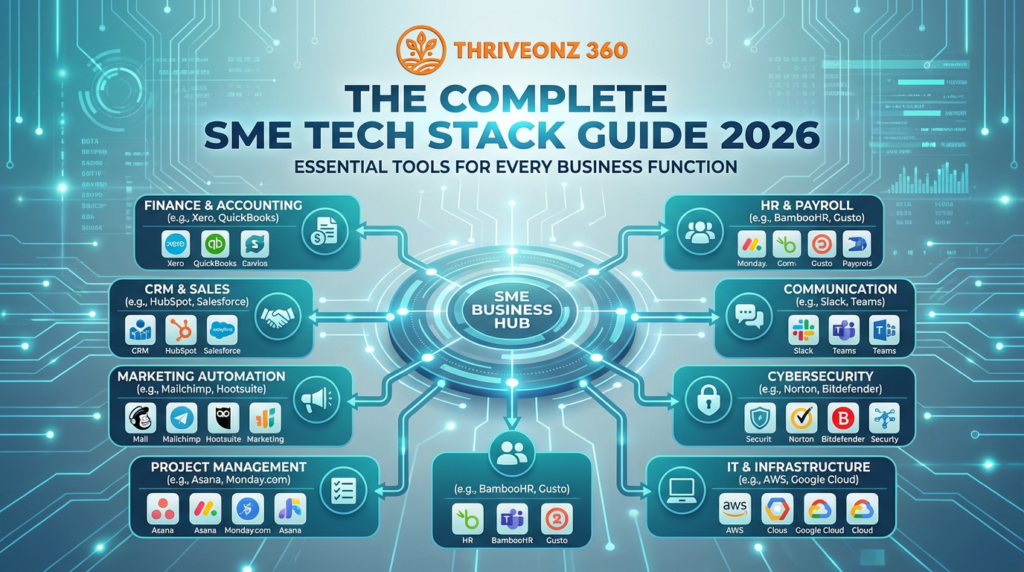
The complete SME tech stack for 2026 runs across eight functional layers: company foundation (Sleek / 1st Formations), accounting (Xero — the integration hub), workforce management (Jibble for attendance, Harvest for project billing), global team management (Deel EOR for 150+ countries), marketing and attribution (Semrush + WhatConverts), sales and conversion (Kartra for digital products, Carepatron for healthcare), travel and expense (Navan + Yesim), and learning and development (Preply Business). A fully integrated 8-layer stack costs 0.53%–2.8% of revenue for businesses between $1M and $10M — less than a single junior hire’s annual salary. The most expensive mistake in SME software buying: accumulation without design. The founder in this guide discovered 41 subscriptions totalling $58,080/year — with no integration between them.
The Complete SME Tech Stack Guide 2026: 8 Layers, 3 Cost Models, One Integration Map
The Complete SME Tech Stack Guide 2026: Essential Tools for Every Business Function
💰 41 Subscriptions. $58,080/Year. Nobody Reviewed the Stack in Three Years.
- The accumulation trap: Each tool added to solve one problem, nobody reviewing the whole picture
- Duplicate functionality: Paying for the same feature in three different tools
- Fragmented data: No integrations — spreadsheets bridging the gaps
- Zapier as duct tape: $299/month managing 23 automations between tools that don’t talk natively
- The right answer: 8 functional layers, one recommended tool per layer, each tool integrated with the one above and below it
✅ Eight Layers. Three Cost Models. One Integration Map.
Layer 1: Company Foundation — Sleek (SG) / 1st Formations (UK)
Layer 2: Accounting — Xero (the hub everything connects to)
Layer 3: Workforce — Jibble (attendance) / Harvest (project billing)
Layer 4: Global Teams — Deel EOR (150+ countries)
Layer 5: Marketing — Semrush (SEO) + WhatConverts (attribution)
Layer 6: Sales/Conversion — Kartra (digital) / Carepatron (healthcare)
Layer 7: Travel — Navan (travel + expense) + Yesim (eSIM)
Layer 8: L&D — Preply Business (language training)
📊 Five Stack Economics That Drive the Decision
2.8%
Of revenue: total stack cost for an S$1.2M Singapore consulting firm using all 8 layers. Costs less than a junior hire’s salary.
0.53%
Of revenue: stack cost for an A$2.4M Australian e-commerce business. Kartra alone generates an estimated A$15–40K in upsell revenue on A$2,268/year investment.
1,000+
App integrations in Xero‘s ecosystem — the accounting layer every other layer connects to.
25%
One-click upsell uptake at checkout in Kartra. 4 launches × 100 buyers × $197 upsell = $19,700/year additional revenue from one stack layer.
Year 3
When integrated stack data compounds into genuine insight: which Semrush keywords → WhatConverts leads → Kartra conversions have 2.4× higher customer lifetime value.
⚡ Quick Actions — Start Building Your Stack
The Accumulation Problem — And Its $58,000 Price Tag
The founder had been running her business for three years when her operations manager handed her a spreadsheet. Not a financial model or project plan. A list of software subscriptions. Forty-one of them. Everything from the accounting platform to the team communication tool to the obscure app someone had signed up for in 2022 that nobody could quite explain but everyone was afraid to cancel. Total monthly spend: $4,840. Annual spend: $58,080. She recognised about half of them.
When she dug in, the pattern was consistent: each tool had been added to solve a specific problem. Nobody had ever looked at the whole picture. Nobody had asked whether data from one system connected to another, whether they were paying for duplicate functionality, or whether the integrations between tools actually worked. The Zapier account alone — managing 23 automations between tools that did not talk to each other natively — was running $299/month and breaking twice a week.
⚠️ How Most SME Tech Stacks Get Built: Not Designed. Accumulated.
The alternative — a deliberately designed tech stack where every tool serves a clear function, integrates with its neighbours, and is chosen against consistent criteria — reduces costs, eliminates data fragmentation, and compounds over time as integrations become more reliable and data more useful. This guide is the deliberate design. See also: Complete Expense Automation Stack: Dext + Xero + Airwallex for the financial sub-stack deep dive.
This guide covers eight functional layers of the SME technology stack, the best platform at each layer, how each layer connects to the others, and the real annual cost of a complete, well-integrated stack for a business of 10–50 people.
Layer 1: Company Foundation and Legal
The Function: Compliant Legal Infrastructure, Made Invisible
Every legal entity needs the administrative infrastructure to stay compliant: registered address, company secretary, annual return filing, nominee directors. Most businesses set this up once and do not think about it again until they receive a compliance notice. The best providers make ongoing compliance invisible — automated, managed, delivered through a platform where the founder never has to think about which deadline is coming.
Sleek (Singapore) — Recommended for SG, AU, HK, UK
Fully digital incorporation. All-in-one: incorporation, corporate secretary, registered address, nominee director, Employment Pass support — one dashboard. AI-powered mail management (government mail digitised and uploaded within 24 hours). SleekSign legally binding e-signatures. Xero Gold Partner — accounting built on Xero for seamless Layer 2 integration.
Ongoing: Annual returns, AGM documentation, director/shareholder changes, CorpPass setup, Employment Pass applications — all managed by Sleek.
Layer 1 → Layer 2: Sleek’s accounting service runs on Xero — ACRA compliance and IRAS financial reporting managed in one provider. See: How to Register a Company in Singapore 2026 →
1st Formations (UK) — Recommended for UK Entity Formation
UK’s leading online company formation service. Same-day Companies House registration from £12.99, fully digital. 200,000+ companies formed, 4.8/5 Trustpilot rating. Complete packages include registered office, company secretary, memorandum/articles templates, VAT registration support, PAYE setup, annual confirmation statement reminders.
For the UK agency expanding to Singapore (Profile 3 below): 1st Formations manages the UK entity while Sleek manages the Singapore entity — two providers for two jurisdictions from a single Layer 1 strategy.
See: 1st Formations vs Rapid Formations UK 2026 → | 1st Formations Full Review →
Layer 2: Accounting and Financial Management — The Stack Hub
The Function: The Financial Nervous System — and the Hub Every Other Layer Connects To
Accounting software is where every financial transaction is recorded, every tax obligation calculated, every invoice created and tracked, every financial report generated. Every other layer in the stack — workforce hours, international payroll costs, travel expenses, marketing spend, course revenue — ultimately flows into this layer.
Critical insight: the platform with the lowest subscription price almost never has the lowest total cost of ownership. A platform that saves $30/month but costs two extra hours of accountant time per quarter costs more than the premium option.
Xero — Recommended for Australia, Singapore, NZ, and UK
Why Xero for Layer 2
- Most reliable bank feeds for AU/SG banks (CBA, Westpac, ANZ, NAB, DBS, OCBC, UOB — direct API connections)
- Market-leading GST/BAS compliance: AU (TPAR, STP Phase 2), SG (GST F5, CPF payroll), UK (MTD-certified VAT)
- 1,000+ integrations — largest app ecosystem in SME accounting
- 65–70% of Australian accounting firms use Xero — the accountant efficiency dividend
- Multi-currency on Premium plans (essential for multi-market operations)
Xero Pricing (AUD)
- Starter: A$32/month (20 invoices/5 bills — very low volume only)
- Standard: A$65/month (unlimited invoicing, 5 payroll employees — right plan for most)
- Premium 5: A$80/month (+ multi-currency)
- Ultimate 20: A$120/month (20 payroll employees, Analytics Plus)
- Singapore: approx. USD $30–75/month with GST F5 and CPF support
Layer 2 Connections — Xero as the Integration Hub
For the complete analysis: Xero Review 2026 → | How to Choose Accounting Software: Complete SME Guide 2026 → | Xero vs QuickBooks vs FreshBooks UK 2026 → | Xero vs Sage vs Wave 2026 → | Dext — Receipt Capture for Xero →
Layer 3: People and Workforce Management
The Function: Connecting When People Work to What They Are Paid
Two distinct profiles: Attendance-based businesses (construction, hospitality, retail, healthcare, field services) need GPS clock-in/clock-out verification with payroll-ready output. Project-based businesses (agencies, consulting, professional services) need time logged against client projects for billing and profitability analysis. Different needs — different recommended tools.
Jibble — For Attendance-Based Businesses
Founded in Kuala Lumpur (2016). Purpose-built for APAC employment contexts. Most affordable comprehensive attendance platform — free for unlimited users, $2.99/user/month (Premium) for GPS and facial recognition.
- GPS clock-in with geofencing — employees can only clock in within the defined work location boundary
- Facial recognition anti-buddy-punching at $2.99/user/month
- Kiosk mode — shared tablet at entrance with facial recognition (no personal device needed)
- Offline clock-in — syncs when connection restored (critical for remote job sites)
- APAC payroll integrations: Xero, MYOB, Employment Hero, Payboy (SG), Talenox, StaffAny
Layer 3 → Layer 2: Jibble payroll export sends verified hours (regular + overtime) directly to Xero payroll — saves 2–4 hours/week for businesses with 15+ hourly employees. See: Jibble Review 2026 →
Harvest — For Project-Billing Businesses
The project billing and time tracking platform for professional services. Best project budget monitoring — real-time burn rate vs. budget with configurable threshold alerts.
- Client invoicing directly from time entries — time tracked → invoice generated in minutes
- Billable utilisation reporting — identify over/under-allocated team members
- Xero and QuickBooks invoice sync — no double entry between time tracking and accounting
- Project management integrations: Asana, Jira, Trello, Basecamp, ClickUp
- Pricing: Free (1 user, 2 projects) → $10.80/user/month Team (annual)
Layer 3 → Layer 2: Harvest invoices sync to Xero automatically — billable hours become client invoices appearing as accounts receivable in Xero without re-keying.
For the complete comparison: Jibble vs Harvest vs Hubstaff 2026: Best Employee Time Tracking → | Connectteam Review UK 2026: Employee App for Deskless Workers → | Best HR Software for UK Small Business 2026 →
Layer 4: Global Team Management
The Function: International Employment Without the Legal Complexity
The moment a business hires in a country where it has no legal entity, it needs this layer. Two accelerating drivers: the normalisation of distributed work (talent in 10 countries is now operationally ordinary) and the intensification of misclassification enforcement (Australia’s Fair Work Act changes, UK IR35 rules, Portugal Law 12/2013). Getting this wrong — paying a contractor who should legally be an employee — is an expensive compliance failure. See: IR35 Guide 2026 and How to Hire in Portugal from UK 2026.
📋 ThriveOnz360 EOR Hub:
Complete UK Employer of Record guide — what EOR is, when you need it, all providers compared, UK PAYE vs EOR, IR35 implications, and a country-by-country cost model.
Employer of Record UK: Complete Guide 2026 →
Deel — EOR in 150+ Countries, Contractor Management in 150+ Currencies
Founded 2019. 35,000+ customers. $12B valuation. Most first-party entities of any EOR provider — not relying on partner networks for key markets including Australia, Singapore, UK, US, Germany, France, India, Brazil.
Deel Key Features
- EOR employment in 150+ countries ($599/month per employee)
- Contractor management: $49/month per contractor, locally compliant agreements, 150+ currencies
- Full HRIS — headcount, time off, documents, onboarding/offboarding across all countries
- Misclassification risk review — contract health checker assesses contractor classification criteria
- Equity management — UK EMI, Australian ESS, Singapore ESOP support
- Immigration support — SG Employment Pass, UK Global Talent Visa, AU Global Talent
Deel Pricing
- Contractor management: $49/month per contractor
- EOR: $599/month per employee
- Global payroll (own entities): $20–29/user/month
- Deel HR (HRIS): $20/month per employee
Layer 4 → Layer 2: Deel payroll journals post to Xero GL — international salary costs, employer contributions, EOR fees all appear as correctly classified expenses. Eliminates manual journal entries for international payroll.
For the complete analysis: Deel Review 2026 (Global) → | Deel Review UK 2026 → | Global Payroll for UK Startups: Deel vs Remote vs Oyster → | Best Global Payroll Software 2026 → | Multiplier — Alternative EOR (Strong APAC) → | Employer of Record UK: Complete Hub →
ThriveOnz 360 — Growth Plan
Exclusive Negotiated Pricing on Every Layer of the Recommended Stack
Growth members unlock: exclusive partner deals on Xero, Kartra, Sleek, Deel, WhatConverts, Semrush, Jibble, Navan, Preply, and more — plus the SME Tech Stack Cost Calculator and Tech Stack Integration Guide (45 pages). Free to join, no credit card required.
Layer 5: Marketing and Demand Generation
The Function: Visibility (Being Found) + Attribution (Understanding What Works)
Two distinct sub-functions: visibility (SEO, content, paid channels) and attribution (which activities generate qualified leads and revenue — not just traffic and clicks). Most SMEs invest significantly in visibility and minimally in attribution. The attribution gap is often the most expensive gap in the entire stack — you can measure website visitors but not which channel generated revenue.
Semrush — SEO and Digital Marketing Intelligence
10M+ marketing professionals. 25B+ keyword database across 143+ countries. The all-in-one SEO visibility platform.
- Competitor analysis — see exactly what keywords competitors rank for
- Position tracking — daily keyword ranking with significant movement alerts
- Site audit — 140+ SEO health checks identifying technical issues
- Content marketing toolkit — Topic Research, SEO Writing Assistant
- Local SEO — Google Business Profile management for multi-location
- PPC intelligence — competitor Google Ads keywords and ad copy analysis
See: Semrush Review 2026 → | Semrush Pricing UK 2026 → | Best SEO Tools for Small Business 2026 →
WhatConverts — Multi-Channel Lead Attribution
The definitive tool for connecting marketing spend to qualified leads and revenue — not just traffic and clicks.
- Dynamic Number Insertion (DNI) — unique tracking numbers per traffic source enable call attribution by source, campaign, and keyword
- Multi-source lead dashboard — phone + form + live chat + ecommerce in one view
- Keyword-level call attribution — identifies which Google Ads keywords generate actual calls
- Lead qualification — distinguishes real leads from noise
- Google Ads conversion import — feeds qualified lead events back for Smart Bidding
- Bi-directional CRM integration (Salesforce, HubSpot, Pipedrive)
See: WhatConverts vs CallRail vs CallTrackingMetrics 2026 → | Best Lead Tracking Software 2026 →
Layer 5 Integration Flows
Layer 5 → Layer 6: WhatConverts qualified leads flow into CRM/Kartra with full attribution data preserved. Layer 5 → Layer 2: Marketing spend (Google Ads) tracked against Xero revenue data to produce true cost-per-customer-acquired. Layer 5 → Google Ads: WhatConverts conversion imports improve Smart Bidding accuracy by feeding qualified leads (not just clicks) back to Google.
Layer 6: Sales and Conversion Infrastructure
The Function: Converting Layer 5 Leads into Revenue
Two business model profiles: Digital/product sales (courses, memberships, coaching, digital products) — conversion happens online through funnels, checkout pages, and email sequences. Service/consultative sales (B2B, consulting, professional services) — conversion happens through human relationships managed in a CRM. For document management and proposals, see PandaDoc UK and the Winning Business Proposals guide.
Kartra — For Digital Products, Courses, and Memberships
All-in-one marketing and course platform: email automation, sales funnels, course hosting, membership sites, affiliate management, checkout optimisation.
- One-click upsells and order bumps — industry standard: 25% upsell uptake, 30% order bump uptake. For 4 launches × 100 buyers × $197 upsell = $19,700/year additional revenue
- Email automation responds to course behaviour — send email when student completes module 3 and has not purchased advanced programme — native because course and email share one database
- Strongest affiliate management in the comparison — multi-tier commissions, marketplace listing, deep funnel attribution
- Funnel A/B testing — split test landing pages, checkout pages, price points
See: Kartra Review 2026 → | Best Online Course Platforms for Creators 2026 →
Carepatron — For Healthcare Practices
Practice management platform for allied health, mental health, and clinical practices. The conversion and operations layer for healthcare.
- Online booking with automated reminders — reduces no-show rates
- NDIS and Medicare billing (Australia) — compliant billing for government-funded healthcare
- Clinical documentation — progress notes, assessments, treatment plans with templated workflows
- HIPAA/PIPEDA-compliant telehealth — secure video consultations
- Practice analytics — appointment volume, revenue per provider, patient retention
- Xero integration — clinical billing revenue posts to Xero for accounting
See: Best Practice Management Software for Healthcare 2026 →
Layer 7: Travel and Expense Management
Navan — Corporate Travel + Expense Management
The dominant next-generation travel management platform (formerly TripActions). All-in-one: flights, hotels, rail, car hire from one interface with negotiated corporate rates. Policy enforcement built in — employees cannot book outside policy without approval.
- Real-time spending visibility — finance sees travel bookings as they happen (not month-end)
- Navan Expense — photograph receipts, auto-categorised and submitted; no manual expense reports
- Xero/QuickBooks/NetSuite integration — travel and expense posts automatically
- Sustainability reporting — carbon footprint tracking per trip for ESG reporting
Layer 7 → Layer 2: Approved expenses post to Xero as correctly coded journal entries — month-end expense pile eliminated, travel costs in management accounts in real time. See: Best Travel Management Software for SMEs 2026 →
Yesim — eSIM for Business Travel (150+ Countries)
Instant mobile data in 150+ countries — no physical SIM card swap, no carrier store visits, activated in minutes from the Yesim app.
- Virtual phone number — local number in destination country without roaming charges
- Hotspot sharing — share eSIM data with up to 5 devices
- Corporate billing — team management with centralised payment and usage tracking
- 24/7 customer support — more responsive than most eSIM competitors
See: Yesim vs Airalo vs Holafly: Best eSIM for Business Travel 2026 →
Layer 8: Learning and Development
Preply Business — Corporate Language Training in 50+ Languages
1:1 tutoring with native speakers. Most effective format for language acquisition vs. app-based platforms (Babbel/Duolingo) with lower completion rates and slower progress.
- 50+ languages — English, Mandarin, Spanish, German, French, Japanese, Korean
- Business English specialisation — lessons built around professional contexts (presentations, negotiations, client emails)
- Corporate dashboard — HR tracks progress, completion, schedules for all enrolled employees
- Custom content — lesson plans built from employee’s actual work materials
Why This Layer Matters
For businesses managing international teams via Deel EOR (Layer 4), language training for locally-hired employees connects directly to the global team management infrastructure. Employees in Germany, France, or Japan enrolled in Preply Business via the same platform accessible globally.
Layer 8 → Layer 4: Training completion reports flow to Deel HR dashboard — international employee development visible in the same system as their employment contract. See: Preply vs iTalki vs Babbel 2026 →
Three Complete Stack Cost Models
Profile 1: Singapore Consulting Firm — 8 People, S$1.2M Revenue
| Layer | Platform | Annual Cost (SGD) |
|---|---|---|
| Layer 1: Company Foundation | Sleek (corporate secretary + registered address) | S$1,200 |
| Layer 2: Xero Accounting | Xero Standard + GST F5 + bookkeeping via Sleek | S$3,600 |
| Layer 3: Time Tracking | Harvest Team (8 users × $10.80/month) | S$1,400 |
| Layer 4: Global Team | Deel EOR (2 AU employees × $599/mo) + Contractor (3 × $49/mo) | S$19,200 |
| Layer 5: Marketing | Semrush Pro ($139.95/mo) + WhatConverts Pro ($100/mo) | S$3,200 |
| Layer 6: Sales | HubSpot CRM (free tier) | S$0 |
| Layer 7: Travel | Navan Expense (8 users × $15/mo) + Yesim Annual (3 frequent travellers) | S$1,740 |
| Layer 8: L&D | Preply Business (4 employees, 2 sessions/month) | S$3,600 |
| Total annual stack cost | ~S$34,000 | |
Profile 2: Australian E-Commerce and Courses — 12 People, A$2.4M Revenue
| Layer | Platform | Annual Cost (AUD) |
|---|---|---|
| Layer 1: Foundation | Direct ASIC registration — ongoing corporate secretary | A$600 |
| Layer 2: Xero Accounting | Xero Standard + A2X ($29/mo) + Dext ($50/mo) | A$1,656 |
| Layer 3: Workforce | Jibble Premium (12 users × $2.99/month) | A$430 |
| Layer 4: Global Team | Deel Contractor (2 PH contractors × $49/month) | A$1,570 |
| Layer 5: Marketing | Semrush Guru ($249.95/mo) + WhatConverts Pro ($100/mo) | A$4,200 |
| Layer 6: Sales/Courses | Kartra Growth ($189/month) | A$2,268 |
| Layer 7: Travel | Navan + Yesim (light travel, 2 team members) | A$800 |
| Layer 8: L&D | Preply Business (2 customer-facing staff) | A$1,200 |
| Total annual stack cost | ~A$12,724 | |
Profile 3: UK Agency with International Expansion — 20 People, £3.5M Revenue
| Layer | Platform | Annual Cost (GBP) |
|---|---|---|
| Layer 1: Foundation (UK) | 1st Formations annual confirmation + registered address | £500 |
| Layer 1: Foundation (SG) | Sleek Singapore (corp sec + address + nominee director) | £2,000 |
| Layer 2: Xero (UK) | Xero Standard UK (£28/mo) + Dext (£30/mo) | £696 |
| Layer 2: Xero (SG) | Xero Standard SG via Sleek accounting | £1,200 |
| Layer 3: Time Tracking | Harvest Team (20 users × $10.80/month) | £2,100 |
| Layer 4: Global Team | Deel EOR (5 international employees × $599/month) | £28,000 |
| Layer 5: Marketing | Semrush Business ($449.95/mo) + WhatConverts Agency | £6,000 |
| Layer 6: Sales | HubSpot Pro ($800/month — justified at this revenue level) | £7,600 |
| Layer 7: Travel | Navan Travel + Expense (20 users) + Yesim (10 frequent travellers) | £5,400 |
| Layer 8: L&D | Preply Business (5 international staff language training) | £3,600 |
| Total annual stack cost | ~£57,096 | |
Implementation Order and the Accumulation Audit
The Recommended Implementation Sequence
Most common stack-building mistake: implementing all layers simultaneously. The cognitive load of configuring seven platforms at once produces inadequate setup in all of them.
- Month 1 — Foundation (Layers 1+2): Legal entity and Xero accounting first. Everything else integrates into Xero — correct chart of accounts before adding other tools ensures integrations work from day one.
- Month 2 — People (Layers 3+4): Configure Jibble → Xero payroll export. Initiate Deel EOR if international hires needed.
- Month 3 — Marketing (Layer 5): Install WhatConverts, connect Google Ads, run initial Semrush keyword audit. Marketing layer benefits from accounting being operational (cost-per-lead needs revenue data).
- Month 4 — Sales (Layer 6): WhatConverts → Kartra/CRM integration connects lead flow to conversion system. Configure Kartra with first product.
- Month 5–6 — Travel + L&D (Layers 7+8): Map Navan expense categories to Xero chart of accounts carefully — misconfigured mappings create cumulative accounting errors.
The Annual Stack Audit — Avoiding the 41-Subscription Problem
The founder from the opening had 41 subscriptions because nobody reviewed the stack in three years. Recommended: annual stack review on the same schedule as annual accounts.
Utilisation check:
- Is each tool being used by the people it was implemented for?
- Has any tool been replaced by functionality now included in another tool?
Overlap check:
- Does any tool duplicate functionality covered by another in the stack?
- Is there native integration available for a connection currently handled by Zapier?
Integration health check:
Frequently Asked Questions
Q: Is this entire stack appropriate for a business just starting out?
No — and it is not designed to be. The 8-layer stack is architected for 10–50 people with $1M–$10M revenue. The minimum viable stack for Year 1: Layer 2 (Xero Starter at A$32/month) + Layer 6 (Kartra Starter at $99/month if selling digital products, or Gumroad free for product validation). Add each new layer with a clear use case. Trying to implement the full stack at launch produces inadequate setup in everything.
Q: What is the most common integration failure in SME tech stacks?
The accounting system integration — tools posting transactions to Xero with incorrect account codes or tax rates. Prevention: review the first three months of posted transactions from every integration carefully (Navan accommodation should post to “Travel & Accommodation” not “General Expenses”). Early correction of misconfigured account mappings prevents cumulative errors that require expensive accountant time to fix.
Q: Do these integrations require technical expertise?
Most are native OAuth connections configured without technical expertise: Jibble → Xero (10 min), Navan → Xero (15 min), Kartra → Xero (30–60 min), Deel → Xero (20 min). The most technically involved: WhatConverts → Google Ads → Smart Bidding configuration, which benefits from familiarity with Google Ads conversion settings. Full step-by-step instructions in the Tech Stack Integration Guide (Growth members).
Q: Should I use Zapier to bridge integrations that are not native?
Sparingly and as a temporary measure. Zapier connections are the most fragile integration method — they break when an API changes, field names update, or a platform modifies authentication. Annually review all Zapier automations: identify connections with native alternatives and retire automations no longer serving their purpose. The founder in this article’s opening was paying $299/month for 23 Zapier automations — most of which had native alternatives she had not discovered. See Complete Expense Automation Guide for the native integration approach.
ThriveOnz 360 — Growth Plan
Exclusive Partner Deals on Every Layer of the Recommended Stack
Growth members unlock negotiated pricing on Xero, Kartra, Sleek, Deel, WhatConverts, Semrush, Jibble, Navan, Preply, and more — plus: SME Tech Stack Cost Calculator, Annual Stack Audit Checklist (PDF), Tech Stack Integration Guide (45 pages, every connection with screenshots), and the Minimum Viable Stack Guide (pre-revenue through $500K). Free to join, no credit card required.
Complete ThriveOnz360 Partner and Tool Index
Company Foundation
- How to Register a Company in Singapore 2026
- 1st Formations vs Rapid Formations UK 2026
- 1st Formations Review UK 2026
- UK vs Singapore: Where to Incorporate 2026
Accounting (Xero)
- Xero Review 2026
- How to Choose Accounting Software: Complete SME Guide 2026
- Xero vs QuickBooks vs FreshBooks UK 2026
- Xero vs Sage vs Wave 2026
- Making Tax Digital UK 2026
- Dext Review UK 2026 (Receipt Capture)
- Complete Expense Automation: Dext + Xero + Airwallex
People and Workforce
- Jibble Review 2026: Free Time Tracking & Attendance
- Jibble vs Harvest vs Hubstaff 2026
- Connectteam Review UK 2026: Employee App for Deskless Workers
- Best HR Software for UK Small Business 2026
Global Teams (Deel)
Marketing and Attribution
- Semrush Review 2026: Complete SEO Platform Analysis
- Semrush Pricing UK 2026
- WhatConverts vs CallRail vs CallTrackingMetrics 2026
- Best Lead Tracking Software for Marketing Teams 2026
- Best SEO Tools for Small Businesses & Startups 2026
Sales and Conversion
- Kartra Review 2026: All-in-One for Creators and Coaches
- Best Online Course Platforms for Creators 2026
- Carepatron vs SimplePractice vs TherapyNotes 2026
- Best Practice Management Software for Healthcare 2026
- PandaDoc UK — Proposal and Contract Software
- How to Create Winning Business Proposals UK 2026
Travel and Learning
- Navan Review 2026: Corporate Travel Platform
- Best Travel Management Software for SMEs 2026
- Yesim vs Airalo vs Holafly: Best eSIM for Business Travel 2026
- Preply vs iTalki vs Babbel: Corporate Language Training 2026
UK Business & Compliance
Last updated: March 2026. Pricing for all platforms based on published rates as of March 2026 — verify current pricing at each provider’s website before purchasing. Cost model figures (2.8%, 0.53%, 1.6% of revenue) are illustrative estimates for the described business profiles using the recommended plan tiers; actual costs vary with team size, plan selection, and add-on usage. Kartra upsell revenue projections (25% uptake, $19,700/year example) are industry benchmarks, not guarantees. ThriveOnz360 receives commissions when members click through to partner products via affiliate links. This does not influence editorial recommendations.
ThriveOnz360 — 60-Second Tool Finder
Not sure which layer to start with?
Answer 5 quick questions. Get a personalised stack recommendation for your business — EOR, payroll, accounting, marketing, and more.

Former City of London fintech advisor and SME growth strategist with 12 years building lean tech stacks for founders across the UK and Southeast Asia. James has guided 500+ SMEs through software decisions that cut costs and unlock growth — and believes every founder deserves a trusted, independent voice on their side. Every review published on ThriveOnz360 follows the platform’s Editorial Standards — tools are independently assessed against UK-specific criteria including HMRC compliance, GBP pricing, FCA registration, and IR35 implications.