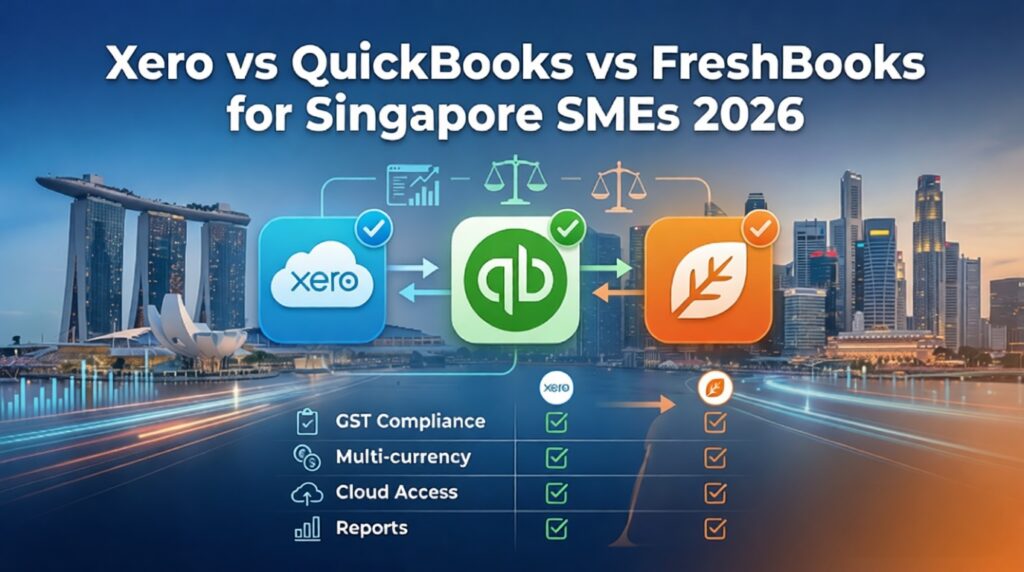
💼 Xero vs QuickBooks vs FreshBooks 2026 — Singapore SME Cloud Accounting Comparison
Your accountant sends the same email every quarter: “I need your invoices, receipts, and bank statements.” You spend 6–8 hours hunting through Gmail and Drive. Your accountant spends 4–6 hours on data entry. You pay S$800–1,500. And the cycle repeats.
- The time drain: average Singapore SME on spreadsheets spends 15–20 hours per quarter on bookkeeping tasks that cloud accounting software automates in minutes
- The hidden cost: missed GST claims average S$2,000–4,000 annually for SMEs with S$500K revenue. Late payment penalties. Cashflow blindness. Accountant fees 50–70% higher than with proper software.
- The IRAS pressure: from 2026, IRAS MTF mandatory electronic GST filing. Only Xero is currently certified MTF-ready — directly relevant if you are GST-registered.
- The choice: three platforms, three philosophies, three business profiles. This guide shows which one fits your business structure, GST status, team size, and accountant relationship.
✅ Three Platforms, Three Business Profiles
Xero (S$40–70/mo): unlimited users, best GST compliance, IRAS MTF-ready, 1,000+ integrations, strongest accountant collaboration via Xero HQ. Built for growing SMEs with multiple stakeholders. Singapore’s most accountant-recommended platform.
QuickBooks Online (S$25–89/mo): strongest inventory management (FIFO on Advanced), deep project costing, highly customisable reporting. Built for established product-based businesses. Best for retail, wholesale, manufacturing, and US-parent subsidiaries.
FreshBooks (S$19–60/mo): easiest learning curve, best-looking invoices, built-in time tracking, native proposal tool. Built for service professionals. Best for freelancers, consultants, and solo businesses billing by the hour.
📊 Singapore Cloud Accounting — The Numbers That Justify the Switch
S$2K–4K
Missed GST claims per year for a typical GST-registered SME with S$500K revenue running on spreadsheets. Cloud accounting with proper GST tagging captures these automatically — equivalent to 1–2 months of software subscription cost recovered in missed claims alone.
30–60 min
Monthly bank reconciliation time with Xero or QuickBooks automatic bank feeds vs 3–5 hours manually. For DBS, OCBC, UOB accounts: feeds import daily, Xero suggests matches, one-click reconciliation. FreshBooks often requires manual CSV import — choose Xero or QuickBooks for reconciliation automation.
Unlimited users
Xero’s defining competitive advantage across all plans from S$40/month. QuickBooks caps at 3 users (Essentials), 5 users (Plus), 25 users (Advanced). For a 4–5 person team: Xero Growing S$55/month is more cost-effective than QuickBooks Plus S$64/month with its 5-user limit.
2026 IRAS MTF
Mandatory electronic GST filing via IRAS Making Tax Filing platform from 2026. Xero: certified MTF-ready (direct submission from Xero to IRAS). QuickBooks: integration planned but not yet certified. FreshBooks: no MTF integration planned. If GST-registered, Xero’s MTF readiness is a material platform advantage.
50–70% lower
Potential reduction in accountant fees with proper cloud accounting software. Accountants spend 4–6 hours on quarterly data entry from disorganised records. With Xero or QuickBooks, that becomes 30–60 minutes of review. Savings compound: S$800–1,500/quarter in accountant billing vs S$200–400 with clean cloud records.
⚡ Quick Actions — Start Your Singapore Accounting Stack
- Xero — 30-Day Free Trial + 90% Off First 6 Months (ThriveOnz360 Growth Members) →
- Complete Expense Automation Guide: Dext + Xero + Airwallex — The Full Singapore Stack →
- Xero Singapore — Setup Guide, Pricing, and Certified Partner Network →
- Airwallex — Multi-Currency Business Account Pairing with Xero (S$100 Credit) →
- Complete SME Tech Stack Guide 2026 — Every Tool for Every Business Function →
- The Hidden Cost of Doing Everything Yourself — Why Finance Automation Changes the Equation →
- Growth Plan (Free) — GST Filing Checklist + Accountant Referral Network + All Partner Deals →
The average Singapore SME running on spreadsheets and paper receipts spends 15–20 hours per quarter on basic bookkeeping tasks that cloud accounting software automates in minutes. The cost is not just time — it is missed GST claims (S$2,000–4,000 annually for businesses with S$500K revenue), late payment penalties, cashflow blindness, and accountant fees that could be 50–70% lower with proper software. Three platforms dominate cloud accounting for Singapore SMEs: Xero, QuickBooks Online, and FreshBooks. Before comparing features, the critical insight is that these three tools are built for fundamentally different business archetypes — choosing the wrong one is not getting a slightly inferior version of the same thing, it is missing the core capability you need entirely.
The Three Philosophies: What Each Platform Was Actually Built For
Xero: Built for Collaboration and Growth
Xero assumes your business has — or will have — multiple people touching financial data: you, your partner, your bookkeeper, your accountant, your operations manager. Unlimited users on all plans. Strongest accountant portal. Natural choice for businesses that prioritise collaboration and preparing for scale.
QuickBooks: Built for Established Operations
QuickBooks carries 40 years of desktop accounting software DNA. Most powerful when your business has inventory to track, complex job costing, detailed customer deposits, or integration requirements with Intuit products. For Singapore SMEs, strongest for product-based businesses with established accounting processes.
FreshBooks: Built for Service Professionals
FreshBooks was designed for freelancers, consultants, and service businesses sending invoices and tracking time — not managing inventory, complex payroll, or multi-entity structures. Prioritises beautiful client-facing documents and time-billable project tracking over deep accounting complexity.
Quick Comparison: All Features at a Glance
| Feature | Xero | QuickBooks Online | FreshBooks |
|---|---|---|---|
| Starting Price (SGD) | S$40/mo | S$25/mo | S$19/mo |
| GST Compliance | Excellent (native) | Good (requires setup) | Basic (manual) |
| IRAS MTF 2026 | ✅ Certified ready | Planned (not certified) | None planned |
| Unlimited Users | ✅ All plans | Tier-based (3/5/25) | Tier-based (max 2) |
| SG Bank Auto-Feeds | DBS/OCBC/UOB + 20+ | DBS/OCBC/UOB + major | Limited (manual CSV) |
| Multi-Currency | 160+ currencies (native) | Yes (Plus+ only) | Yes (paid plans) |
| Inventory Management | Yes (basic) | Best (FIFO on Advanced) | None |
| Built-In Time Tracking | Via apps only | Via apps only | ✅ Native |
| Accountant Collaboration | Excellent (Xero HQ) | Good | Weak |
| App Integrations | 1,000+ | 650+ | 100+ |
| Invoice Quality | Good | Good | Best (client-facing) |
| Proposal Tool | Via apps | Via apps | ✅ Native (Plus+) |
| Reporting Depth | 80+ reports | 100+ (most customisable) | 20+ (basic) |
| Singapore Payroll | Add-on S$10–20/mo | Add-on S$30–50/mo | Via integrations |
| Learning Curve | Medium | Medium–High | Easiest |
| G2 Rating | 4.3/5 | 4.3/5 | 4.5/5 |
Platform 1: Xero — The SME Champion for Singapore
Overview & Pricing
Xero (founded 2006, New Zealand; NZX/ASX listed) is the leading cloud accounting platform for SMEs across APAC, UK, Australia, and New Zealand. 3.95 million subscribers globally. Singapore’s most accountant-recommended platform — most accounting firms serving SMEs are Xero-certified partners. Defining advantage: unlimited users on every plan.
- Early: S$40/mo — 20 invoices + 5 bills/mo, bank reconciliation, GST tracking, Hubdoc receipt capture, unlimited users
- Growing: S$55/mo ⭐ — unlimited invoices/bills, multi-currency, project tracking, expense claims, full GST reporting, purchase orders, Hubdoc
- Established: S$70/mo — everything in Growing + payroll integration (5 employees), Analytics Plus advanced reporting
- Payroll add-on: S$10/mo (1–4 employees), S$20/mo (5–10 employees) — CPF, SDL, FWL compliant, integrated with Xero accounting
Feature 1: GST Compliance + IRAS MTF Readiness (Best in Comparison)
GST tracking on every transaction (standard, zero-rated, exempt, out-of-scope), import GST scheme with reverse charge, bad debt relief per IRAS rules, GST F5 return data ready to file, period lock for filed periods. From 2026: Xero is certified IRAS MTF-ready for direct electronic GST submission — eliminating the manual IRAS portal data entry step. QuickBooks has announced plans but is not yet certified. FreshBooks has no MTF integration planned.
Feature 2: Unlimited Users (Defining Competitive Advantage)
Every Xero plan from S$40/month includes unlimited users: business owner, co-founder, finance manager, operations manager, bookkeeper, external accountant — all accessing real-time financial data with no per-user cost escalation. QuickBooks Essentials (S$50/month) allows 3 users. QuickBooks Plus (S$64/month) allows 5 users. For a 4–5 person team, Xero Growing (S$55/month, unlimited) is more cost-effective than QuickBooks Plus (S$64/month, 5-user cap). As you scale, you never face “should we buy another seat?”
Features 3–4: Accountant Collaboration + 1,000+ Integrations
Xero HQ: accountants create free Xero accounts, access all client files from one unified portal, work in client files as internal staff with full audit trail. Most Singapore accounting firms are Xero-certified partners — Xero is the accountant’s platform of choice. Accountant access costs the client nothing extra.
App ecosystem: 1,000+ integrations covering payroll (Talenox, CompareHero), e-commerce (Shopify, WooCommerce, Lazada, Amazon), POS (Lightspeed, Vend, Square), expense management (Dext, Expensify), CRM (HubSpot, Salesforce), payment gateways (Stripe, PayPal), and time tracking (Harvest, Toggl). For a Shopify e-commerce business: automatic order → invoice → inventory update without 5–10 hours of weekly manual data entry.
✅ Xero Strengths
- Best GST compliance for Singapore — native, not bolted-on
- Certified IRAS MTF-ready for 2026 mandatory e-filing
- Unlimited users on all plans (unique in this comparison)
- Strongest accountant collaboration via Xero HQ
- Largest app ecosystem (1,000+ integrations)
- 160+ currencies native (not a paid add-on)
- Automatic bank feeds for all major Singapore banks
- Most Singapore accounting firms are Xero-certified partners
❌ Xero Weaknesses
- More expensive than QuickBooks Essentials or FreshBooks Lite at entry level
- Inventory management less detailed than QuickBooks Advanced (no FIFO native)
- No built-in time tracking — requires Harvest, TSheets, or Toggl integration
- Singapore payroll is an add-on (S$10–20/month extra)
- Not the right fit for solo freelancers who just need simple invoicing
See: Xero Singapore — Setup Guide, Certified Partner Network, and Pricing → | Dext + Xero + Airwallex: Complete Expense Automation Stack →
Platform 2: QuickBooks Online — The Global Standard
Overview & Pricing
QuickBooks (Intuit, NASDAQ: INTU) is the world’s most widely used accounting software — 7M+ subscribers globally and 40 years of desktop accounting DNA. QuickBooks Online brings that depth to the cloud. For Singapore SMEs, strongest for product-based businesses where inventory tracking accuracy directly impacts COGS and profit margin visibility.
- Simple Start: S$25/mo — 1 user, invoicing, expense tracking, receipts, basic GST, mileage
- Essentials: S$50/mo — 3 users, bills, time tracking, multi-currency (limited), GST
- Plus: S$64/mo ⭐ — 5 users, project profitability, inventory tracking, full multi-currency, purchase orders, advanced GST
- Advanced: S$89/mo — 25 users, FIFO inventory costing, custom permissions, dedicated account team, advanced analytics
- Payroll add-on: S$30–50/mo — full Singapore CPF compliance
Feature 1: Inventory Management — Best in This Comparison
QuickBooks Advanced inventory: track quantity on hand, reorder points, COGS; FIFO (First-In-First-Out) costing on Advanced plan for accurate inventory valuation; inventory valuation reports; low stock alerts (native — Xero requires app); barcode scanning via third-party; backorder management; vendor management. For a 500-SKU wholesale business where COGS accuracy is material to profit margin reporting, QuickBooks Advanced is the stronger choice. Xero handles basic inventory (weighted average); FreshBooks has none.
Feature 2: Job Costing + Customisable Reporting
Job costing (Plus+): assign revenue and expenses to specific projects, track profitability per project in real time, compare estimated vs actual costs, time tracking per project via QuickBooks Time, project-specific invoicing. Best for construction, agencies, and professional services billing by project where per-job profit visibility is business-critical.
Reporting: 100+ standard reports, customise any report (columns, filters, date ranges), memorise custom reports, export to Excel, schedule automatic report delivery. Strongest reporting customisation in this comparison — preferred for board presentations, investor reporting, or detailed internal KPI tracking.
Feature 3: Singapore Bank Feeds (Comparable to Xero)
QuickBooks supports DBS, OCBC, UOB, Citibank, HSBC, Standard Chartered with automatic daily imports, bank rules for automatic categorisation, and mobile receipt capture. Comparable to Xero on bank feed quality — the distinction is in Xero’s stronger GST handling and unlimited users, not in the bank feed layer itself.
✅ QuickBooks Strengths
- Strongest inventory management (Advanced plan FIFO costing)
- Deep project costing and job profitability tracking
- Most customisable reporting (board/investor-ready)
- 40+ years of legacy and global brand trust
- Good Singapore bank feed integration
- Strong for US-parent subsidiaries needing Intuit consistency
❌ QuickBooks Weaknesses
- Per-user pricing increases cost as team grows (vs Xero’s unlimited users)
- 3-user cap on Essentials, 5-user cap on Plus — restrictive for growing teams
- S$64/month Plus is more expensive than Xero Growing S$55/month for comparable features
- US-centric feature design creates occasional friction for Singapore use cases
- Accountant collaboration less seamless than Xero HQ
- IRAS MTF integration planned but not yet certified
Platform 3: FreshBooks — The Service Professional’s Tool
Overview & Pricing
FreshBooks (founded 2003, Toronto) was designed for freelancers, consultants, and service businesses that prioritise beautiful client-facing documents, time tracking, and proposal-to-invoice workflows. Easiest to learn of the three — a deliberate trade-off of reduced accounting depth for ease of use. Best for Singapore sole proprietors and small consulting practices not yet GST-registered.
- Lite: S$19/mo — 5 billable clients, unlimited invoices, expense tracking, time tracking, credit card payments, basic reports
- Plus: S$33/mo ⭐ — 50 billable clients, proposals, project profitability, team time tracking
- Premium: S$60/mo — unlimited clients, 2 team members, advanced reports, retainer invoicing
- Select: Custom — high-volume, dedicated account manager, custom onboarding
- Payroll: via third-party integrations (Talenox, Payboy) — no native Singapore payroll
Feature 1: Best-Looking Client-Facing Invoices
FreshBooks has the most professional, design-quality invoice templates in this comparison — 10+ templates, full branding (logo, colours, fonts), automatic late payment reminders, online payment acceptance (credit card, PayPal), deposit and partial payment options, recurring invoices for retainer clients. For an architectural firm or design consultancy where client-facing documents reflect brand quality: FreshBooks invoices look agency-designed. Xero and QuickBooks invoices are functional but not aspirational.
Feature 2: Built-In Time Tracking (No Integration Required)
FreshBooks includes time tracking natively — Xero and QuickBooks both require third-party app integrations (Harvest, TSheets, Toggl). Start/stop timer from desktop or mobile, manual time entry, time tracked by project and client, billable vs non-billable time, team time tracking, budgeted hours vs actual, direct conversion of tracked time to invoice. For consultants and lawyers billing by the hour: this is the feature that makes FreshBooks the right tool. One click from “start timer” to “invoice sent” with no separate app, no export/import, no reconciliation.
Feature 3: Proposal Tool (Native — Plus Plan+)
Pre-built proposal templates, project scope and deliverables, pricing options (client selects package), eSignature built in, automatic conversion of signed proposal to project and invoice. Full workflow: send proposal → client signs in browser → FreshBooks creates project with budgeted hours → track time → generate invoice from tracked time. Neither Xero nor QuickBooks has native proposal functionality — both would require PandaDoc, Proposify, or similar at additional cost. For service businesses where the sales cycle starts with a proposal, FreshBooks wins the end-to-end workflow.
✅ FreshBooks Strengths
- Easiest learning curve — designed for non-accountants
- Best-looking, most professional client-facing invoices
- Built-in time tracking (no third-party integration needed)
- Native proposal tool for service businesses
- Excellent expense tracking and receipt capture
- Most affordable entry price (S$19/month Lite plan)
- Best for solo professionals — clean, focused, not overwhelming
❌ FreshBooks Weaknesses
- No inventory management — not suitable for product businesses
- Weak Singapore bank feed support — often requires manual CSV import
- Limited GST automation — more manual GST tracking required
- No IRAS MTF integration planned (significant for GST-registered businesses)
- Only 20+ reports vs 80–100+ in Xero and QuickBooks
- Weaker accountant collaboration — no equivalent to Xero HQ
- Client limits on lower tiers (5 clients on Lite) feel restrictive early
Head-to-Head: GST, Users, Banks, and Inventory
GST Compliance for Singapore
| Capability | Xero | QB | FB |
|---|---|---|---|
| GST transaction tagging | Auto | Setup req’d | Manual |
| GST F5 return data | Ready to file | Ready to file | Manual |
| Import GST (reverse charge) | Yes | Manual | No |
| Bad debt relief | Yes | Limited | No |
| IRAS MTF 2026 | Certified ✅ | Planned | None |
Verdict: Xero dominates GST compliance for Singapore.
Multi-User Access vs Cost
| Users Needed | Xero | QuickBooks | FreshBooks |
|---|---|---|---|
| 1 user | S$55 | S$64 | S$60 |
| 3 users | S$55 ✅ | S$64 | Cannot |
| 5 users | S$55 ✅ | S$64 | Cannot |
| 10 users | S$55 ✅ | S$89 | Cannot |
Verdict: Xero is unbeatable for multi-user teams of any size.
5 Use Case Scenarios: Which Platform Wins
Scenario 1: Singapore E-Commerce Startup (Shopify, 2 Co-Founders)
Profile: Shopify apparel store, S$40K/month revenue (growing), 2 co-founders, GST-registered, 150 SKUs, selling in SGD/USD/MYR, external accountant for year-end.
→ Xero Growing (S$55/month)
- Both co-founders + accountant access (unlimited users)
- Shopify integration — automatic order → invoice → inventory
- Multi-currency native (SGD, USD, MYR)
- GST compliance for quarterly filing
- DBS/OCBC bank feeds
Scenario 2: Solo Marketing Consultant (Hourly Billing)
Profile: Solo consultant, 15 active clients, S$150–250/hour, not GST-registered, needs time tracking + beautiful invoices.
→ FreshBooks Plus (S$33/month)
- Built-in time tracking (start/stop timer, no integration)
- 50-client limit (15 active, room to grow)
- Beautiful branded invoices
- Proposal tool for new client pitches
- Simple expense tracking for client reimbursements
Scenario 3: Wholesale Distributor (500 SKUs, FIFO Required)
Profile: Electronics wholesaler, S$3M/year revenue, GST-registered, 500 SKUs with FIFO costing requirements, 5 staff, SGD/USD/CNY multi-currency.
→ QuickBooks Plus (S$64) or Advanced (S$89)
- Advanced inventory with FIFO costing (critical for accurate COGS)
- 5 users on Plus, 25 users on Advanced
- Purchase order management
- Detailed inventory valuation reports
- Multi-currency and GST compliance
Scenario 4: Law Firm (3 Partners, 2 Admin, Hourly Billing)
Profile: Law firm, S$1.2M/year revenue, GST-registered, billable hours critical, external accountant, international clients.
→ Xero Growing (S$55/month)
- All 5 users + accountant (unlimited)
- Multi-currency invoicing for international clients
- GST compliance and IRAS MTF readiness
- Accountant collaboration via Xero HQ
- Project tracking for matter profitability
- Time tracking via Harvest/TSheets integration
Scenario 5: Restaurant Group (3 Locations, POS, Multi-Account)
Profile: 3-location restaurant group, S$2.5M/year, GST-registered, Lightspeed POS, 6 people needing access (owner, ops manager, 3 location managers, accountant), multiple bank accounts.
→ Xero Growing (S$55/month)
- All 6 people + accountant access (unlimited users)
- Lightspeed POS integration (automatic sales data import)
- Multi-location tracking via tracking categories
- Bank feeds for 3+ accounts
- GST compliance
💰 Payroll Cost Comparison
| Payroll Need | Xero | QuickBooks | FreshBooks |
|---|---|---|---|
| 1–4 employees | +S$10/mo | +S$30–50/mo | External app |
| 5–10 employees | +S$20/mo | +S$30–50/mo | External app |
| CPF/SDL/FWL compliance | ✅ Integrated | ✅ Integrated | Via Talenox/Payboy |
Xero Payroll add-on is significantly cheaper than QuickBooks Payroll for equivalent CPF/SDL/FWL compliance.
Frequently Asked Questions
New Singapore business — do I need accounting software immediately?
If GST-registered (mandatory over S$1M revenue, optional if projecting S$1M+): yes, immediately. GST compliance requires transaction-level tracking that spreadsheets cannot reliably manage. Under S$200K revenue and not GST-registered: FreshBooks Lite or spreadsheets are acceptable to start. Most accountants recommend cloud accounting from Day 1 to build clean financial records for future fundraising, IRAS review, or business sale.
Which platform do most Singapore accountants prefer?
Xero has the strongest accountant adoption in Singapore. Most accounting firms serving SMEs are Xero-certified partners managing all client files via Xero HQ. QuickBooks has strong adoption among accountants serving larger businesses or US-headquartered subsidiaries. FreshBooks has the weakest accountant collaboration tools. If you are hiring a local Singapore accountant, the probability they use Xero is higher than either alternative.
How does IRAS MTF affect my platform choice in 2026?
IRAS Making Tax Filing (MTF) introduces mandatory electronic GST submission from 2026. Xero is certified MTF-ready — direct submission from Xero to IRAS, eliminating the manual IRAS portal data entry step. QuickBooks has announced integration plans but is not yet certified. FreshBooks has no MTF integration planned. For any GST-registered business, Xero’s MTF certification is a material and time-sensitive platform advantage.
Can I switch platforms later?
Yes, but migration has costs. Most Singapore accounting firms charge S$500–2,000 for platform migration depending on transaction volume and cleanup required. Data export/import is straightforward but chart of accounts mapping and historical data integrity require careful handling. Choose thoughtfully upfront. The most common migration: FreshBooks → Xero as businesses grow past S$500K revenue and become GST-registered. Migration is possible but avoidable with the right first choice.
Which bank feeds work best for Singapore?
Xero and QuickBooks both offer excellent automatic bank feed integration with DBS, OCBC, UOB, Citibank, HSBC, Standard Chartered, and Maybank. Both support daily automatic imports, bank rules for auto-categorisation, and one-click reconciliation. FreshBooks has significantly weaker bank feed support and often requires manual CSV import for Singapore banks. For bank reconciliation automation, Xero or QuickBooks are strongly preferred.
I pair Xero with Airwallex — does it integrate?
Yes — Xero and Airwallex integrate natively. Airwallex multi-currency transactions sync automatically to Xero, with exchange rates applied correctly per transaction. For Singapore businesses with APAC trade (SGD, USD, MYR, CNY, AUD), running Airwallex for international payments and Xero for accounting creates a complete financial stack. ThriveOnz360 Growth members get S$100 credit on Airwallex and 90% off Xero first 6 months — see: Airwallex integration guide →
Final Recommendations
🏆 Growing SMEs, GST-Registered, 3+ Users → Xero Growing (S$55/month)
- Best GST compliance — native, IRAS MTF-certified
- Unlimited users (unbeatable for teams)
- Strongest accountant collaboration (Xero HQ)
- 1,000+ app integrations
- 160+ currency native multi-currency
- Most Singapore accounting firms are certified partners
Start: 30-day free trial. Growth members: 90% off first 6 months → Unlock Deal (Free) →
🏆 Product Businesses, Inventory-Heavy → QuickBooks Plus/Advanced (S$64–89/month)
- Best inventory management in comparison
- FIFO costing on Advanced plan
- Deep project costing and job profitability
- Most customisable reporting
- Purchase orders and vendor management
- 30-day free trial available
Note: 5-user cap on Plus — if 6+ users needed, Xero Growing (S$55, unlimited) is more cost-effective.
🏆 Freelancers & Service Professionals → FreshBooks Plus (S$33/month)
- Built-in time tracking — no integration needed
- Best client-facing invoice design
- Native proposal-to-invoice workflow
- Easiest learning curve
- Most affordable for solo professionals
- 30-day free trial available
Upgrade path: When GST-registered or 3+ team members needed → migrate to Xero Growing.
🎁 Exclusive ThriveOnz360 Resources — Singapore Accounting Stack
ThriveOnz360 — Growth Plan (Free)
Stop Paying S$800–1,500/Quarter for What Software Does in Minutes
Growth members unlock: Xero 90% off first 6 months · Airwallex S$100 credit · Dext 20% off · GST Filing Checklist · Singapore Accountant Referral Network · Complete SME Tech Stack Guide · All 50+ partner tool deals. Free — no credit card required.
Related Reading — Singapore Finance, Operations & Business Tools
ThriveOnz360 has affiliate relationships with Xero and receives referral commissions when members use partner links. This does not influence editorial recommendations. Pricing in SGD correct as of March 2026 — verify current pricing directly with each platform before purchasing. IRAS MTF certification status reflects public announcements as of March 2026; verify current status with IRAS and each platform before making platform decisions based on MTF readiness.